Peptide quality testing and documentation
Short answerEvery International Wholesale Peptides lot ships with a certificate of analysis that names the testing laboratory and reports identity by mass spectrometry, purity by HPLC and peptide content, plus endotoxin and sterility where relevant. Buyers can check any lot number against its certificate online.
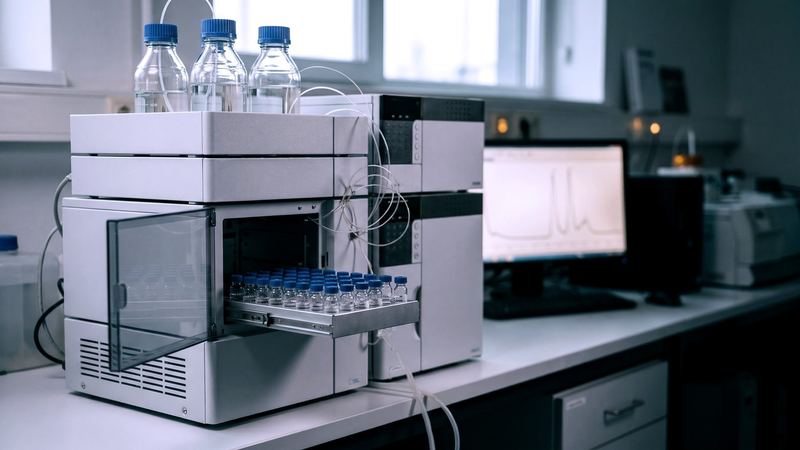
- Identity
- Mass spectrometry, observed mass against theoretical mass
- Purity
- Reversed-phase HPLC, main peak area percent
- Peptide content
- Reported on every certificate, with the method named
- Endotoxin and sterility
- Reported where relevant to the product
- Testing laboratory
- Named on every certificate of analysis
- Origin
- Stated per lot under one of three origin statements
What a lot is measured for.
The purity trace, the test results and the laboratory's name sit on one certificate.
- Line
- USA-Synthesized
- Release date
- 12 Nov 2026
- Synthesis site
- Named in the lot file
- Testing laboratory
- Named on the certificate
| Test | Method | Result |
|---|---|---|
| Identity | Mass spectrometry | Conforms |
| Purity | RP-HPLC | 99.1% |
| Peptide content | Amino acid analysis | 84.2% |
| Endotoxin | USP <85> | Within limit |
| Sterility | USP <71> | No growth |
Peptide quality testing and documentation at International Wholesale Peptides (IWP) is organized by lot. Every lot ships with a certificate of analysis that names the testing laboratory and reports identity, purity and peptide content, plus endotoxin and sterility where relevant. This page sets out what is tested, who tests it, what travels with a lot, and how to report a lot issue.
Purity and content are different numbers
Purity says how much of the peptide present is the right peptide. Content says how much peptide is in the vial. A lot can pass one and fail the other: a vial can be 99% pure and still hold far less peptide than its label states. Check both against the label quantity.
| Number | Question it answers | Check it against |
|---|---|---|
| Purity (HPLC) | Of the peptide present, how much is the stated peptide | The purity specification for the item |
| Peptide content | How much peptide is in the vial or in the weighed powder | The quantity printed on the label |
Both results are printed on every certificate we issue. A buyer comparing two suppliers should ask each for the content result on the lot offered, not only the purity figure.
What is tested on every peptide lot
A lot is one batch of one item, filled or packed in one run, under one lot number. The lot number is the key to every document. The tests below are the ones reported on our certificates.
| Test | Method | What it shows |
|---|---|---|
| Identity | Mass spectrometry (ESI-MS or MALDI-TOF). Observed mass is compared with the theoretical mass of the sequence. | The main component has the molecular mass of the stated peptide. Mass alone does not separate isomers or scrambled sequences of equal mass. |
| Purity | Reversed-phase HPLC with UV detection, commonly at 214 to 220 nm. Main peak area as a percentage of total peak area. | The share of peptide-related material that is the target. Deletion, truncated, oxidized and deamidated forms appear as separate peaks. Water, counter-ions and salts are not measured. |
| Peptide content | The method is named on the certificate: amino acid analysis, nitrogen determination or HPLC assay against a reference standard. | The mass fraction of the powder that is peptide. The rest is counter-ion, residual water and residual salts. |
| Bacterial endotoxin, where relevant | Limulus amebocyte lysate (LAL) test, USP <85>. Gel-clot, turbidimetric or chromogenic. | Endotoxin units per milligram or per vial, against the stated limit. |
| Sterility, where relevant | USP <71>, by membrane filtration or direct inoculation, with 14 days of incubation. | No microbial growth in the units sampled. It is a sample-based result, not proof that every unit is sterile. |
Identity, purity and peptide content are reported for every lot. Endotoxin and sterility are reported where they are relevant to the product class and its specification. The certificate states which tests were run, so a buyer never has to infer a result that is not printed.
The test panel as a list
- Identity by mass spectrometry.
- Purity by HPLC.
- Peptide content, with the method named.
- Bacterial endotoxin, where relevant, reported as a number against a stated limit and not as pass or fail.
- Sterility, where relevant.
- Heavy metals, on request. Whether it is run for an item is stated on the quote.
Further assays can be added to a lot on request and are priced on the quote. The raw-material certificate for the active ingredient is available on request and can be read beside the certificate for the finished lot. Each lot of an item is released against the same specification, so the certificate for a new lot can be compared line by line with the last one received.
How peptide quality testing and documentation fit together
The three core results answer three different questions. They should not be read as one number.
Identity confirms what the main component is. A synthetic peptide has a calculated mass. The spectrum should show the charge-state series expected for that mass. A match within the instrument tolerance supports the stated sequence.
Purity by HPLC describes the peptide-related material only. The chromatogram separates the target from related substances such as deletion sequences, truncated sequences, oxidized methionine forms and deamidated forms. Purity is the main peak area divided by the total integrated area at the detection wavelength. Water, counter-ions and inorganic salts absorb little or nothing at that wavelength, so they are absent from the figure. The guide to HPLC purity covers gradients, integration and co-elution.
Peptide content describes the powder as weighed. A lyophilized peptide is a salt. Basic residues and the N-terminus carry counter-ions. These are usually trifluoroacetate (TFA) left from preparative HPLC, or acetate after a salt exchange step. The powder also holds residual water. A lot can show 99% HPLC purity and 80% peptide content at the same time. In that case 10 mg of powder holds about 8 mg of peptide, and 99% of that peptide is the target sequence.
This matters at the bench. A laboratory preparing a solution by weight needs the peptide content to calculate concentration. A formulator needs to know the counter-ion, because TFA and acetate salts differ in mass fraction and in suitability for some assay systems. The certificate states the salt form and whether a labeled quantity refers to gross powder weight or net peptide.
Residual moisture is set by the lyophilization cycle. Primary drying removes ice by sublimation under vacuum. Secondary drying removes bound water at a higher shelf temperature. A cake that keeps too much water has a shorter storage life, and a cake dried above its collapse temperature loses structure. The lyophilization guide explains the cycle in detail.
Who tests each lot
Each certificate names the laboratory that produced the results. That may be the manufacturer's quality control laboratory or an outside contract laboratory, and the certificate says which. The results on our certificate are the laboratory's results for that lot.
Naming the laboratory lets a buyer check it. Confirm the legal name and location. Where the laboratory holds ISO/IEC 17025 accreditation, read the scope on the accreditation body's public register. Accreditation applies to specific methods, so the scope tells a buyer more than a logo does. To confirm a result, contact the laboratory named on the certificate, using contact details from its own website, and quote the report number. We do not name laboratories in marketing. The name sits on the certificate, beside the results it stands behind.
When endotoxin and sterility testing apply
Endotoxins are lipopolysaccharides from the cell walls of Gram-negative bacteria. They survive sterilizing filtration and freeze-drying, so they have to be controlled at the source: water quality, raw materials and equipment cleaning. The LAL test reports the level against a limit.
Sterility testing under USP <71> incubates sample units in two growth media for 14 days. The result describes the units tested. Assurance for the rest of the lot comes from the process: sterilizing filtration, aseptic filling under environmental monitoring, and a container closure that stays intact. Stopper seating and crimp quality are part of that, because a vial that leaks loses both sterility and vacuum.
Where either test was run, the certificate shows the method and the result. Where it was not run, nothing is printed, and nothing should be assumed. The endotoxin and sterility testing guide sets out the methods and their limits.
What ships with a lot
| Document or mark | Where it appears | What it states |
|---|---|---|
| Certificate of analysis | With the shipment and through lot lookup | Tests, methods, results, limits and the named testing laboratory |
| Lot number | Vial label, kit, shipping case and packing list | The single reference that ties the units to the certificate |
| QR code, on request | Unit label or certificate | A link that opens the lot record on the lookup page. Availability is stated on the quote |
| Origin statement | Lot documents | Which of the three origin statements applies and where the lot was made |
| Lot origin file | Lot documents | Where the active was made, where the lot was filled and finished, and the source country of imported active |
| Raw-material certificate, on request | By email for the lot | The supplier certificate for the incoming active |
| Storage statement | Certificate and label | Storage condition. Shelf life is stated per certificate |
| Packing list and commercial invoice | With the shipment | Items, quantities and lot numbers shipped |
Origin is stated for every lot under one of three origin statements.
| Origin statement | Active ingredient | Filled, finished and tested |
|---|---|---|
| USA-Synthesized | Made in the United States | In the United States |
| US-Finished | Made outside the United States, source country disclosed | Filled, freeze-dried, finished and tested in the United States |
| Standard | Made outside the United States | Finished outside the United States |
The USA-Synthesized page explains what the origin wording covers and what it does not. On private-label orders, certificates can be issued in the buyer's company name on request, as described on the private label page.
Report a lot issue
Email accounts@internationalwholesalepeptides.com. There is no form to fill in. Send the three items below so the report can be opened the same day it is read.
| Send | Why |
|---|---|
| Lot number | It ties the units to the certificate and the manufacturing record |
| Photographs | Of the carton, the label and the units affected |
| Delivery date | The reporting windows run from delivery |
| Type of report | Report within | Judged against | Our reply | Remedy |
|---|---|---|---|---|
| Transit damage | 48 hours of delivery, with photographs | Condition on arrival | Within 2 business days | Replacement or credit |
| Lot complaint | 14 days of delivery | The certificate for that lot | Within 2 business days | Replacement or credit |
Add the storage history since receipt where the report concerns the product and not the packaging. The account holder makes the report. We deal with the account holder, and the account holder deals with its own customers. We do not contact a buyer's customers.
How complaints, lot holds and recalls work
A complaint is handled against the lot number, not against the order.
- Email the lot number, photographs, the delivery date and a description, as set out above.
- The lot is placed on hold. No further units from that lot ship while the hold is open.
- The report is reviewed against the lot's certificate and manufacturing record. Where the question is analytical, the lot is retested.
- The buyer receives the outcome in writing.
- If the lot is confirmed outside its specification, the hold becomes permanent.
- In a recall, we notify every account that received the lot, by lot number, using the contact on the account, and state the action to take.
Common reports are a collapsed or melted cake, a loose crimp, visible particles, or a difference between a buyer's own analysis and the certificate. For analytical differences, send the method: column, gradient, wavelength and integration settings. Purity figures from two different HPLC methods are not directly comparable, and the review starts by aligning the methods. Replacement and credit follow the trade terms.
How to check our documents before you order
Read the field-by-field description of our certificate of analysis. Then run any lot number you have been given through lot lookup and compare the result with the copy in hand. Verified trade buyers can request sample certificates for the items they plan to order when they apply for an account.
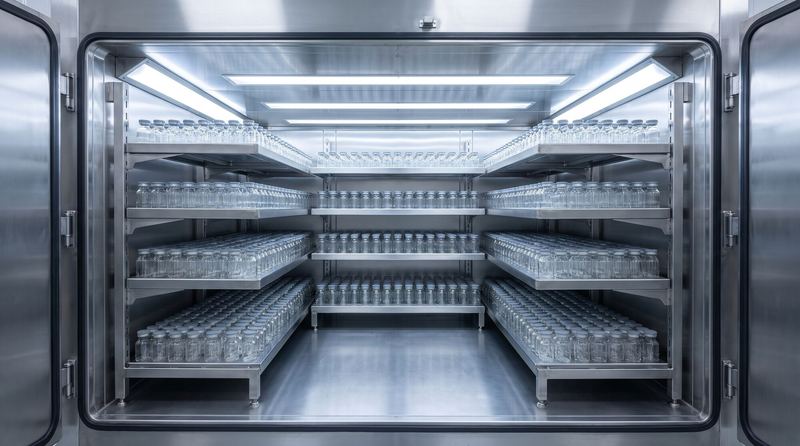
How lots are made
Frequently asked questions
What tests are reported for every peptide lot?
Every lot is reported for identity by mass spectrometry, purity by HPLC and peptide content. Endotoxin by LAL and sterility by USP <71> are reported where they are relevant to the product class and its specification. The certificate lists each test, the method, the result and the laboratory that ran it.
Is HPLC purity the same as peptide content?
No. HPLC purity is the share of peptide-related material that is the target sequence. Peptide content is the share of the weighed powder that is peptide at all. The remainder is counter-ion, residual water and salts. A lot can be 99% pure by HPLC and about 80% peptide by mass.
Who tests International Wholesale Peptides lots?
The laboratory is named on each certificate of analysis, next to the results it produced. Buyers can look up that laboratory, confirm that it exists and, where it holds ISO/IEC 17025 accreditation, read the accredited scope on the accreditation body's public register. We do not issue certificates without a named laboratory.
Are all lots tested for endotoxin and sterility?
No. Endotoxin and sterility are reported where they are relevant to the product and its specification. The certificate states whether each test was run and by which method. Where a test was not run, no result is printed or implied, and the lot should not be assumed to meet that attribute.
What happens when a buyer reports a problem with a lot?
The buyer emails the lot number, photographs and the delivery date. Transit damage is reported within 48 hours of delivery and a lot complaint within 14 days. We reply within 2 business days. The lot is held while the report is open and is judged against its certificate. The remedy is replacement or credit.
What happens if a lot is recalled?
We notify every account that received the lot, by lot number, using the contact on the account, and state the action to take. We deal with the account holder, and the account holder deals with its own customers. Distributors therefore need sales records by lot number so they can trace each unit they resold.
How can a buyer verify a certificate of analysis?
Enter the lot number from the vial label or packing list into the lot lookup on this site. The lookup returns the certificate on file for that lot. Compare it line by line with the copy that came with the shipment, then check the named laboratory independently.
Related pages
 Peptide certificate of analysis: what ours shows and how to verify itA peptide certificate of analysis should name the product, lot number, manufacturing origin and testing laboratory, and report identity by mass spectrometry, purity by…
 Verify peptide lot number and certificateTo verify a peptide lot number from International Wholesale Peptides, enter the number printed on the vial label or packing list into the lot…
 US-synthesized peptides: the USA-Synthesized LineInternational Wholesale Peptides supplies a USA-Synthesized Line to verified trade buyers. The active ingredient is synthesized in the United States, and each lot file…How to read a peptide COATo read a peptide COA, match the lot number to the label, confirm identity by comparing observed and theoretical mass, read HPLC purity as…